
Identify Who Owns a Clay County Property
First results deserve a second look. Skip the urge to trust one name on one screen. Clay County splits its evidence among three offices. The GIS viewer fixes location. Assessment records carry the tax roll owner. The Recorder's deed records prove conveyance. Work the trail from the easiest clue toward the strongest public confirmation.
- Enter the street address in Clay County WTH GIS and select the matching parcel.
- Record its parcel number, situs address, displayed owner name, and legal-description clues.
- Compare that identity with the county Tax List or the DLGF Assessed Value Search.
- Ask the Clay County Recorder for the newest deed affecting that parcel and confirm its grantee.
One wrinkle follows a recent sale. The assessment roll can lag behind a newly recorded deed, so the newest instrument may name the current owner first. Hold the parcel number steady the whole way. A mailing address or a street spelling alone can send you to the wrong land.
Trace the Address Through Clay County WTH GIS
WTH GIS accepts several inputs. Type an address, intersection, parcel number, owner name, or free text. Lead with the address, because it pins the search to one place. Then hit Identify on the selected shape. Roads and named boundaries help separate close matches. Identify Areas shows the jurisdiction surrounding the parcel.
The map supplies a lead, not legal proof. Parcel lines are reference graphics that can differ from a survey or the deed description. Save the parcel number. WTH's Print tool accepts a title and notes. Its Email link preserves the map, highlight, and detail view for a research file.
The official Clay County GIS source leads to the viewer and its parcel details.
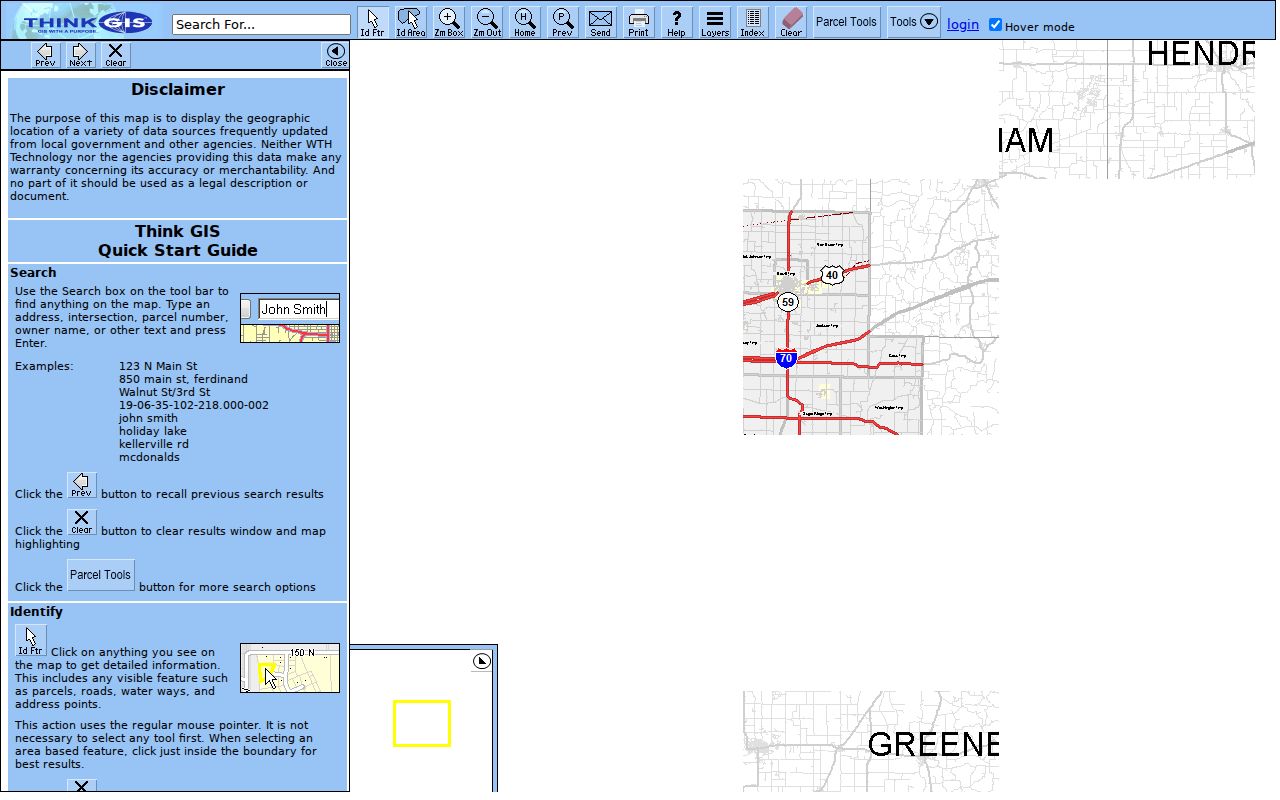
A parcel selected in the viewer does the bridging work. It turns an everyday street address into the stable identifier that the assessment roll and the deed records both use.
Read Clay County's Owner-of-Record Evidence
Ownership questions land first at the Assessor. That office keeps the assessment roll, with fields for owner name, situs address, mailing address, land and improvement assessments, and exemptions. The county-hosted Tax List adds a Name field, and the state DLGF search will take a partial surname. Neither proves the named person lives there.
Four ownership terms
Owner of record means the name on the current roll. A grantee receives an interest under a deed. The situs address is where the land sits, while the mailing address is where tax and assessment notices go, and it may be in another state entirely.
The Tax List flags itself “Not for Official Use.” Treat its results as clues. Note the update information it posts. Take anything that matters to the Assessor, Auditor, Treasurer, or Recorder for verification. A lookup grows stronger when the parcel number, legal description, and owner identity all agree, and the Clay County Assessor page leads straight to the office that keeps the roll.
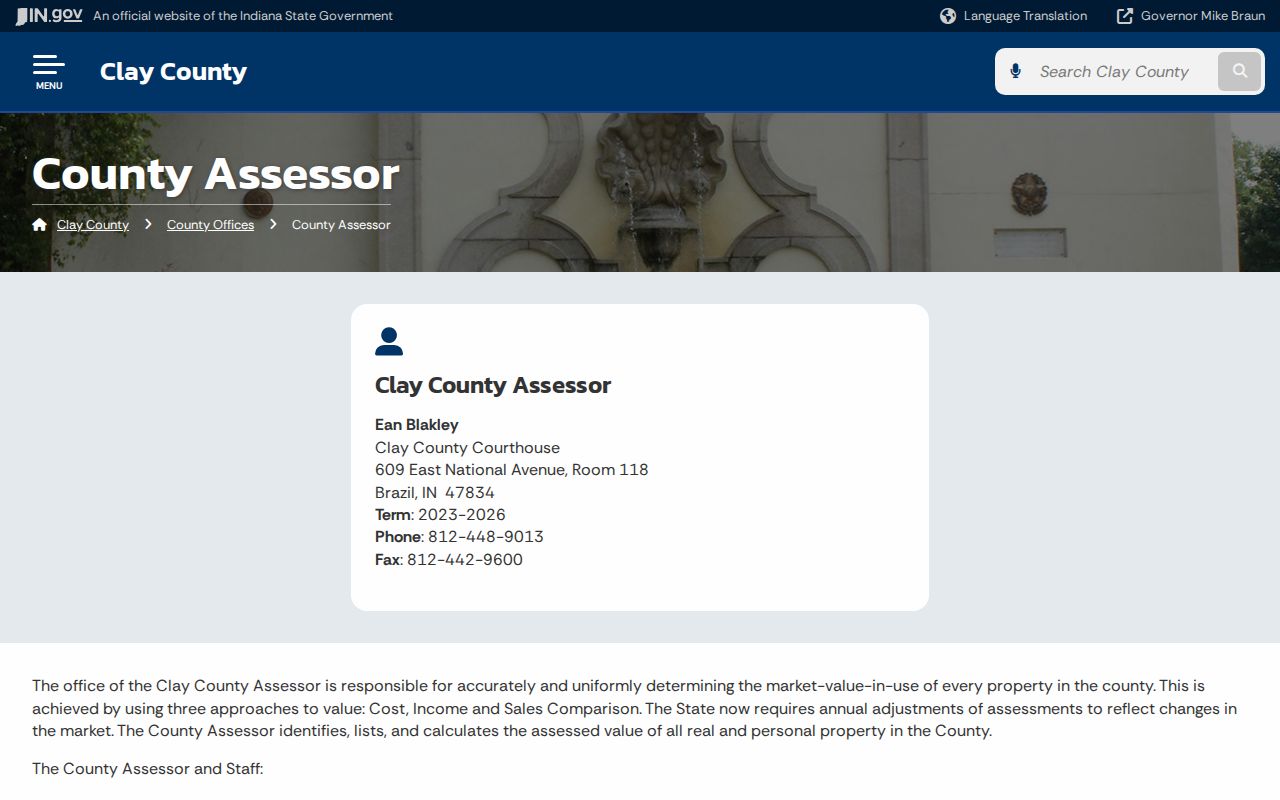
The Assessor's page itself is not a parcel card. Getting the owner still calls for the Tax List or DLGF result, plus the Recorder confirmation described here.
Where Clay County Property Ownership Is Shown
No single screen settles every Clay County ownership question. Each source carries its own date, purpose, and authority, so compare them rather than swap one for another.
| Ownership source | What it contributes | How to reach it |
|---|---|---|
| Assessment roll | Owner name, mailing and situs addresses, value fields | County Tax List, DLGF search, or Assessor |
| Recorder instrument | Latest grantee, grantor, recording reference, legal description | Recorder counter, phone, or records request |
| WTH GIS | Parcel location, identifier, displayed owner, nearby boundaries | Free county-linked viewer |
| INBiz business record | Entity identity and registered-agent clues when an LLC holds title | Public Indiana business search |
The Recorder's official page offers no public grantor-grantee portal. For an instrument check, call 812-448-9005 or visit Room 111 of the Clay County Courthouse. Indiana's APRA, IC 5-14-3, still opens a request route for non-posted public records. Expect exemptions and reasonable production time.
Confirm the Clay County Owner With the Newest Deed
The Recorder works best with specifics. Bring the parcel's owner name, a legal-description clue, and any deed reference shown on the property material. Ask for the most recent conveyance touching the parcel. On that instrument, compare the grantee, the recording date, the book and page or instrument number, and the legal description against the parcel you mapped.
Deeds do not always convey whole tracts. One may transfer part of a parcel, a mineral interest, or a building on leased land. Clay County's tax-sale examples include trusts, LLCs, odd name prefixes, and subdivision labels. Match the land description, not just the party name.
Confirmation rule. The assessment owner is a useful present-tense lead, but the newest recorded deed is the stronger current public evidence after a recent sale.
Resolve Clay County LLC, Trust, and Estate Owners
Entity owners change the search. Copy the spelling and punctuation exactly as the roll shows it. Then try sensible variants. One local Tax List entry reads “10 C's Llc.” It is a reminder that apostrophes, abbreviations, and capitalization can make or break a name search. When the name result wobbles, search the parcel number as the control.
For an Indiana company, the INBiz public business search can pin down the entity name. It can also offer registered-agent or filing clues. Trusts hide behind trustees. A trust may appear under its trustee. An estate transfer can call for the Clay County Clerk's probate file. It can also call for an executor's deed. Probate explains who had authority. The Recorder's instrument shows the land moving.
Note: A business filing or probate file explains a party's role. But only a matching land instrument ties that party to the parcel.
Follow Clay County Ownership Beyond Today's Roll
The tax roll answers who owns a Clay County parcel today. Tracing earlier owners takes a different route. Start from the current owner of record. Then walk the chain backward, deed by deed. The Recorder publishes no stated cutoff for its online deed index. Older work depends on that office and on historical collections. An assumed web range is not the guide.
The Indiana State Library's microfilm guide covers Clay County deed books. It also holds grantor/grantee indexes. Both run from 1825 through 1902. Those volumes matter here. An 1851 courthouse fire destroyed most pre-1851 county records, yet Recorder records survived the blaze. So a missing early probate or court file does not erase the land trail itself. Deed records remain the durable spine of Clay County property research.
For a step-by-step reverse-chain method, see the Clay County past property owners guide. Along the way, keep one research log. Record each party, the transfer date, the deed type, its reference, and the parcel description.
Limits on a Clay County Property Owner Lookup
Any Clay County property owner lookup has real limits. An owner field names the owner of record. It does not identify every occupant. It cannot prove a transfer is valid, surface unrecorded interests, or stand in for a title examination. Mailing addresses add their own wrinkles, since a tax bill may go to a manager, a trustee, a business office, or a second residence rather than the parcel itself. Indiana's Address Confidentiality Program can also substitute an address for a qualifying participant, and restricted information should never be defeated through cross-searching.
Lawful use. Use Clay County property owner records for legitimate land research, purchase diligence, boundary questions, estate work, or civic review. Never use them to stalk, threaten, harass, or harm a person.
Even clean official records carry quirks. Old spellings, stale addresses, partial interests, and plain indexing mistakes all show up in Clay County deed and tax roll entries. When a purchase, inheritance, easement, or ownership dispute hangs on the answer, pull the actual instrument from the custodian and consult qualified title or legal help.