
Read Clay County Deeds by Instrument Type
Every deed type moves land differently. Clay County deed records capture conveyances of many kinds. Each instrument typically shows the party names, a recording date and reference, and a legal description. Consideration or a sales disclosure may add context to the transaction. The Recorder's public document list uses one broad "Deed" category. Read the document itself to learn what kind of conveyance took place. Don't rely on an assumed online filter.
| Deed form | What it records | Common research use |
|---|---|---|
| Warranty deed | A conveyance with stated warranties | Follow a conventional purchase |
| Quitclaim deed | Whatever interest the grantor holds | Trace family, estate, or title cleanup |
| Trustee or fiduciary deed | A representative acting under authority | Connect a trust or probate transfer |
| Sheriff's or tax deed | A transfer following a statutory sale | Research foreclosure or delinquent tax proceedings |
| Personal representative's deed | An estate's authorized conveyance | Link a court order to land |
Not everything recorded beside a deed conveys ownership. Mortgages, liens, easements, and covenants can appear on the same books while leaving title untouched. Releases and partial releases matter just as much. Recording gives public notice of an instrument. It never guarantees that every claim behind it was resolved.
Clay County's Permanent Trail Is in Room 111
Clay County Recorder Susan Maesch works from 609 E National Avenue, Room 111, Brazil, Indiana 47834, and takes calls at 812-448-9005. The office records deeds, mortgages, liens and releases, UCC filings, surveys, plats, easements, powers of attorney, environmental disclosures, underground utilities, highway rights-of-way, and other listed instruments. That breadth makes Room 111 the hub of any deed search.
The county offers no online grantor-grantee index, parcel or document-number search, image viewer, or stated coverage cutoff. Call or visit with names, an approximate date, a parcel identifier, and a legal-description clue. Ask staff how the current index and images are accessed. A commercial database is not the county's official deed search, so do not assume it carries the authoritative record.
The official Recorder office page is the authoritative contact and instrument-list source for Clay County.
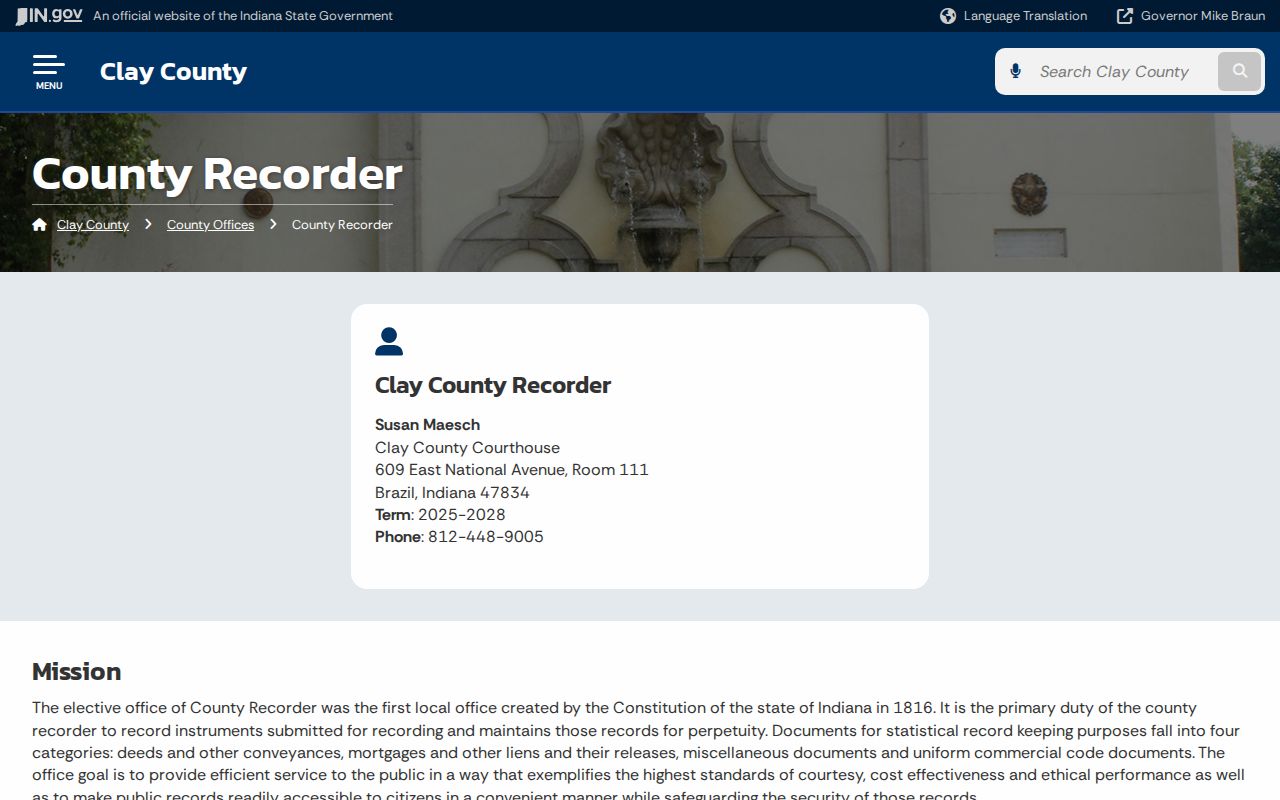
The page confirms the counter route but no live index. A phone call or courthouse visit completes the search.
Trace Clay County Grantors and Grantees
A grantor conveys an interest. A grantee receives it. Start by identifying the parcel through the Clay County property search, pull the newest deed, and copy the party names, date, legal description, and book/page or instrument reference. Then search for the earlier acquisition by treating that deed's grantor as a prior grantee, and repeat the cycle.
- Confirm the parcel number and legal-description wording in GIS and tax sources.
- Ask Room 111 for the newest deed and record its grantor, grantee, date, and reference.
- Search the grantor as a grantee in an earlier date range.
- Compare legal descriptions for exceptions, splits, combined tracts, and lot changes.
- Repeat until the present index ends, then continue in deed books and microfilm.
- Grantor
- The party conveying the stated interest.
- Grantee
- The party receiving the stated interest.
- Chain of title
- The linked sequence of transfers for the same land.
- Recording reference
- A book/page or instrument key used to retrieve the document.
Names alone can mislead. Keep every suffix, initial, trustee capacity, and bit of LLC punctuation intact at each step, along with the complete legal description. Someone who lived at the address or paid a bill there was not necessarily the titled grantee.
Deed Books Survived Clay County's 1851 Fire
Clay County was organized in 1825. An 1851 courthouse fire destroyed most pre-1851 records. Recorder records survived, according to the Indiana State Library Clay guide. That makes deed books a rare early source. They can carry evidence where probate files, judgments, and other courthouse papers no longer exist.
The State Library microfilm finding aid documents deed books and indexes covering 1825 through 1902. These include the overlapping 1883–1902 L-1, L-2, and L-3 grantor/grantee runs. Note the reel, volume, page, names, date, and description at every step. That way another researcher can reproduce the whole chain.
Note: The documented historic deed trail begins in 1825, but no official source supplies the earliest year in the current online index.
Get a Clay County Deed Copy
Call the Recorder before sending money. The county offers no online image-order service, so copies move through the office itself. Supply the recording reference when you have it. Otherwise provide the grantor and grantee, a date range, the parcel number, and the legal description. Ask staff to confirm the page count, delivery method, total cost, and whether a plain or certified copy suits your intended use.
| Deeds and other instruments | $25 recording charge, including one oversize page |
|---|---|
| Mortgages | $55, including subordinate or re-recorded mortgages |
| Additional oversize page | $5 per page exceeding 8.5 by 14 inches |
| Multiple-transaction instrument | $25 plus $7 per cross-reference after the first |
| Copy up to 11 by 17 | $1 per page |
| Larger copy / certification | $5 per larger page; $5 certification |
Fee details deserve a second look. The official mechanic's-lien wording is ambiguous around a $25 instrument charge and a $2 mailout line, so verify those items directly with the office. Filing fees and copy fees answer different questions.
Recorded, not guaranteed. Clay County deed records document filed instruments, not a title opinion. Unrecorded interests, description defects, or unresolved claims can require a qualified title professional or attorney.
Use Indiana APRA for Non-Posted Recorder Material
When a deed record is not posted online, the Indiana Access to Public Records Act, IC 5-14-3 still applies. It covers existing, non-exempt records held by the Recorder. Narrow the request first. Name the specific document you want. Ask for it in whatever electronic format already exists. A phone or in-person request must draw a response within 24 hours. Mailed, emailed, or faxed requests get seven calendar days. Those windows only cover acknowledgment, though, not delivery of the deed copy itself.
Recorder charges rest on their own statutory schedule. It can differ from ordinary APRA copy rates. The office has no duty to build a custom title analysis. Nor must it create a new parcel map, or a fresh index for a requester. If access is refused, ask which exemption or other legal basis applies.
General Public Access Counselor guidance lets a non-state local agency charge the greater of ten cents per black-and-white page, twenty-five cents per color page, or actual cost under the stated formula. Certification can run up to five dollars. Those ceilings are not the Recorder's instrument-specific rates. Confirm with the custodian which authority governs the deed record you want. Then get a cost estimate before authorizing any large reproduction.
Build a Reproducible Clay Deed Log
Every Clay County deed search deserves a written log. For each index or book search, note the spelling you entered and the variants tried. Add the date range, the source, the deed type, and the recording date. Record the grantor, grantee, legal description, reference, and the next name to chase backward. Keep mortgages, releases, easements, plats, probate matters, and judgments on separate lines. This discipline guards the chain against same-name mix-ups. It also exposes missing intervals right away.
Older place descriptions often need translation. The State Library catalog holds an 1896 directory. It also holds a 1915 owner map, and Clay map and plat holdings spanning 1867 through 2020. Treat these as context, not conveyances. The recorded deed remains the land connection that counts.
Never bridge a changed description silently. Flag the exception or added tract. Weigh acreage only as a clue, and hunt down the plat, survey, auditor split, or court order that resolves it. For entities, preserve the capacity in which each signer acted. Compare deed spellings against Indiana business records without mistaking a registered agent for the landowner. For estates, pair the probate authority with the recorded fiduciary deed.
The final worksheet should separate confirmed transfers from open leads. Note whether each document was seen as an index entry, a plain image, a certified copy, or a microfilm page. That single detail tells a later reviewer how much evidence stands behind the ownership sequence. It also shows which item still needs pulling from the Clay County Recorder.
Close by comparing first and last legal descriptions, not just owner names. Track retained mineral interests, rights-of-way, utility language, acreage exceptions, and plat references. A transfer appearing only in a tax roll or directory stays labeled an inference until the deed or court authority turns up. This separation of clues from recorded proof matters especially in Clay County. Historic Recorder books survived the courthouse fire there, but other early evidence did not.
Beside each unresolved interval, write one concrete next action. Call Room 111 for the current index. Request a particular book and page. Inspect a named probate file or retrieve a referenced plat. An action-oriented log stops repeated broad searches. It also keeps the chain pinned to the same parcel as street labels, spellings, and recording systems shift.