
Decode Clay County Property Tax Records
Three offices build Clay County property tax records together. The Assessor estimates market-value-in-use and values the land and improvements separately. The Auditor then calculates the tax. It applies deductions and certifies ownership for zoning. It records splits and combinations and processes appeal paperwork. Finally the Treasurer bills and collects the resulting amount. The Treasurer tracks delinquency and runs any authorized tax sale. Always match the parcel number and tax year before comparing figures across offices.
| Field | What It Shows | Where |
|---|---|---|
| Land assessment | Tax-year value assigned to the land component | Assessor / property card |
| Improvement assessment | Tax-year value assigned to structures and improvements | Assessor / property card |
| Gross assessed value | Total land and improvements before deductions and caps | DLGF Details / Form 11 |
| Deductions and exemptions | Adjustments administered for qualified parcels or owners | Auditor and assessment roll |
| Bill and payment status | Amount billed, paid, or delinquent | Treasurer |
| Tax-sale status | Published delinquency, sale, and redemption information | Auditor / Treasurer / official notice |
Indiana assesses at market-value-in-use with a statewide 100% ratio. Yet that figure still need not match a sale price or an appraisal. A recorded deed shows one transaction. The tax bill then layers on deductions, caps, and taxing calculations. Those sit beyond gross value. Treat the assessment and the bill as related but distinct property records.
Ask the Right Clay County Tax Office
Assessor Ean Blakley's office sits in Courthouse Room 118. It is reachable at 812-448-9013, Monday through Friday 8 a.m. to 4 p.m. Staff there identify, list, and value property using cost, income, and sales-comparison approaches. Annual adjustments are part of the work. One wrinkle: an official DLGF letter names Barbara Scott while the county page names Ean Blakley. So call the office line rather than trusting any single name on time-sensitive material.
Auditor Patti Foxx works from Room 105 at 812-448-9001. Treasurer Jennifer Flater is in Room 101 at 812-448-9009. The split of duties is clean. The Treasurer handles bills, collections, delinquency, and tax sales. The Auditor handles calculations, deductions, parcel changes, appeal forms, and tax-sale publication. Knowing it prevents a common delay. A value question belongs first with the Assessor. A deduction or split goes to the Auditor, and a balance goes to the Treasurer.
Search the Clay Tax List Carefully
The county Tax List shows fields for Dist#, Parcel #, Name, Tax Year, Property Address, and Maximum. Controls include Search, Next, Back, Home, and Clear. The list holds 26,075 records and displays results in windows of 1–100. Search by parcel number first. If that fails, try the property address or the owner spelling exactly as recorded.
The screen itself reads "Not for Official Use." Treat it as a locator only, not a certified balance or proof of owner of record. Note the tax year and parcel number shown. Then confirm the amount with the Treasurer or the assessed value with the Assessor. A recent split or combination can hide a parcel. The office advises searching the owner's surname for the last two years or calling the Treasurer directly.
Note: The official Treasurer page, reachable through its county source, is the right destination for payment and delinquency questions.
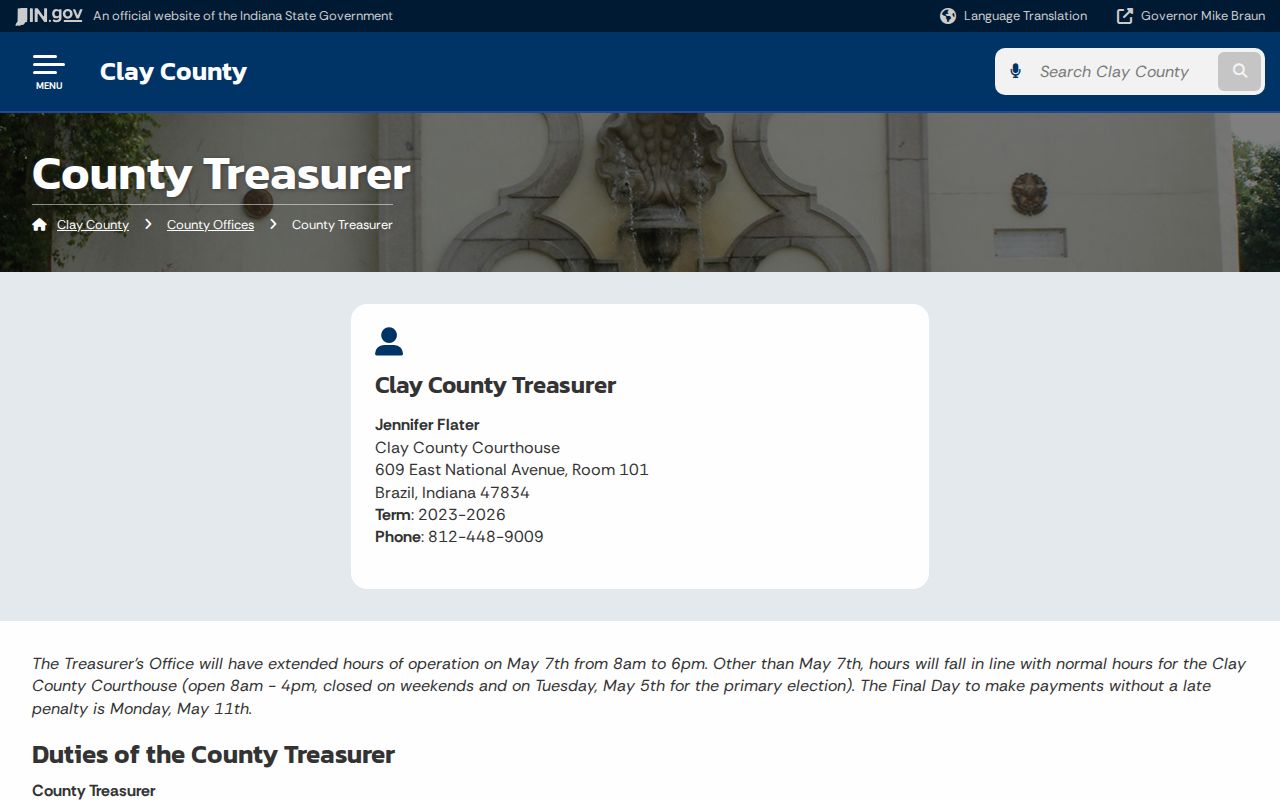
Note: The official Treasurer page anchors payment and delinquency questions to the office that actually holds the balance.
Look Up a Clay County Tax Bill
Clay County typically mails annual statements in late March or early April. There is no separate fall mailing. That schedule makes the tax year and installment status the first things to check. Payment options are broad: at the counter, by mail, through the west-side ramp drop box, at participating local banks during coupon windows, by QR code, by IVR at 812-412-2577, and online through AutoAgent. Confirm current instructions before paying.
- Use the parcel number to locate the correct year in the Tax List or Treasurer route.
- Record the billed amount, payment status, and any delinquency notation.
- Compare gross assessed value and deductions with the Assessor/Auditor record.
- Ask the Treasurer to confirm the payoff or official balance before relying on it.
- Check Auditor and official sale notices if delinquency or a tax sale appears.
- Assessed value
- The tax-year valuation assigned under Indiana assessment rules.
- Tax rate or levy
- The governmental calculation applied within the relevant taxing district.
- Deduction or exemption
- A qualified adjustment administered through the Auditor/assessment process.
- Tax lien
- A claim arising from unpaid property tax; it is not the same as a deed.
Compare Clay Values in the DLGF Search
The DLGF Assessed Value Search takes tax year, county, a partial street name, and a partial surname. Each result carries Details and Download buttons. Leave off street direction and type where the instructions say so. Counties supply the data. The statewide tool works well for finding and comparing records, but corrections go back to Clay County.
The row that matters is "Assessed Value Total Land and Improvements." That is the gross figure before deductions and caps. Keep assessment year and payable year straight. One year's assessment generally drives the next year's bill. A property-card search can add owner, mailing and situs addresses, land and improvement details, transfers, and sale price. Clay County offers no county-hosted card interface online.
Note: The state assessed-value search page is the official statewide route for comparisons.
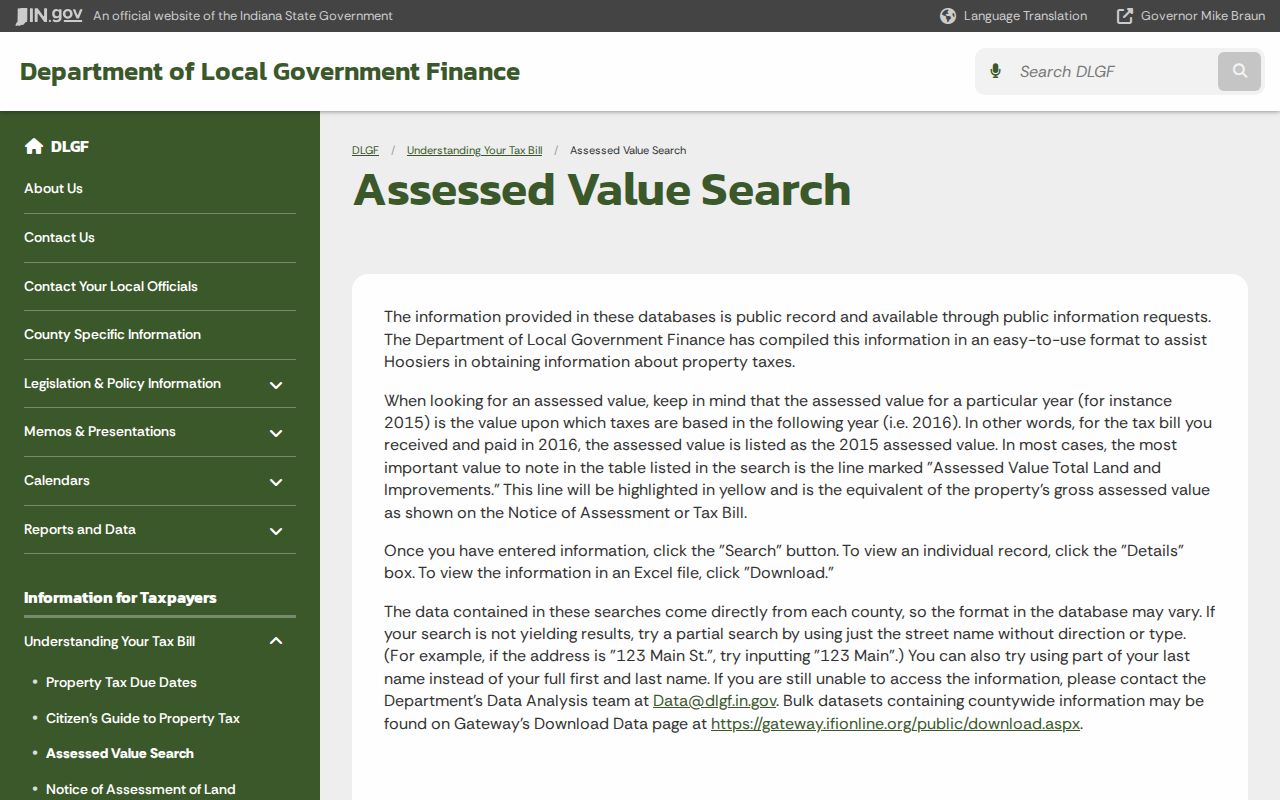
The state screen is a handy comparison point. For corrections, bills, and deduction questions, though, the Clay offices remain the custodians of the actual property records.
Clay's 2025 Deduction Change
A July 3, 2025 Auditor announcement widened over-65 and disability deduction qualifications. It set income limits of $60,000 for a single return and $70,000 for a joint return. Existing recipients needed to take no action, and questions went to the Auditor. Eligibility rules and forms shift over time. So treat the announcement as a prompt to confirm current requirements rather than proof of qualification.
Deductions change the taxable result without touching gross assessed value or deed ownership. Keep the application, the approval or denial, the tax year, and the resulting tax roll entry together. That distinction matters when comparing two similar parcels. It also matters when reconciling a bill against DLGF's gross land-and-improvements total.
Clay County Enters the 2026 Reassessment Cycle
Indiana runs reassessment on a four-year wheel. The latest turn began July 1, 2026 for the 2026-payable-2027 cycle. Inspectors visit roughly a quarter of parcels each year. Clay County wrapped the plan into a 2026–2030 procurement. It covers residential, agricultural, commercial, and industrial work. The contract also covers new construction, annual adjustment, and appeal representation. The Assessor can confirm how that contract came out.
The DLGF signed off on Clay County's 2025 ratio study on April 2, 2025. Its statistical review weighed the median ratio, coefficient of dispersion, and price-related differential. It also weighed sales chasing, vertical equity, and change analysis. A 100% assessment ratio is a system-wide benchmark. It does not promise any single parcel's assessed value will match its sale price.
The official statewide reassessment page shown here lays out the current cycle.
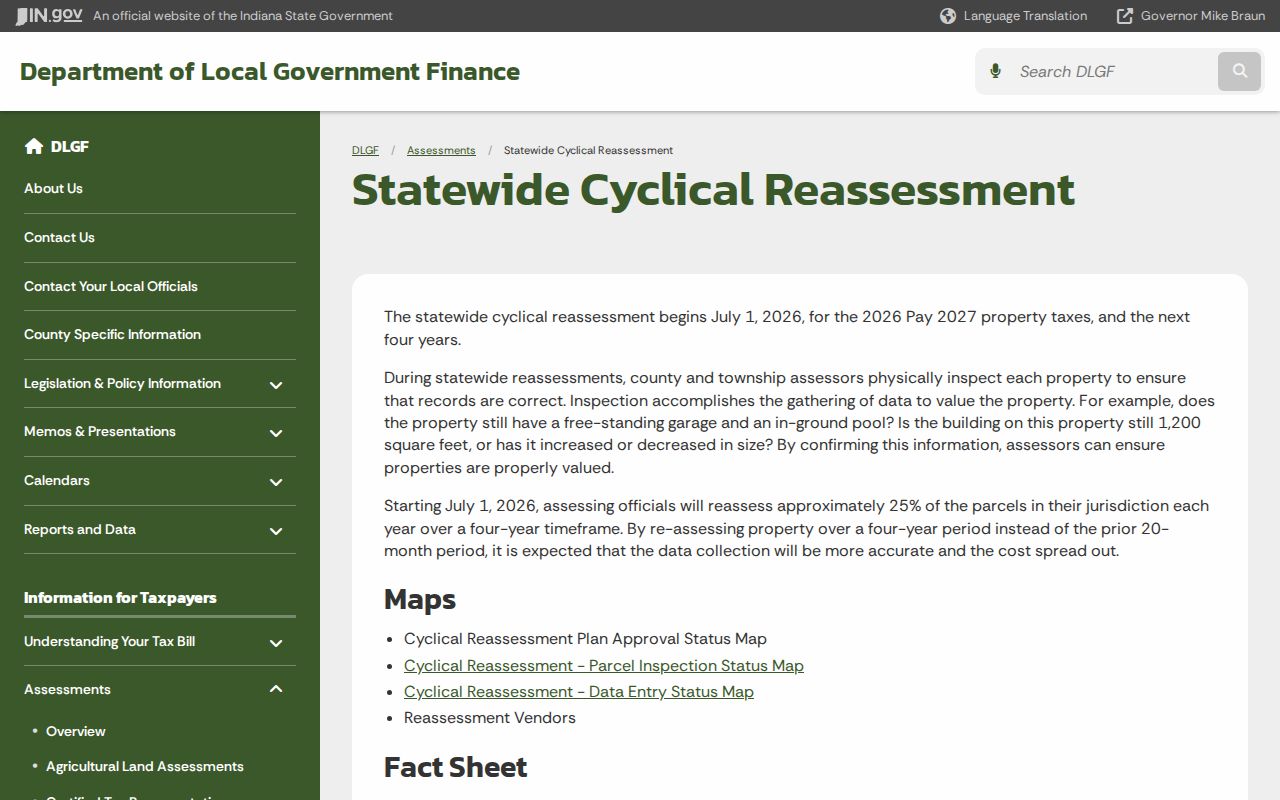
That schedule explains why a value moved. It does not explain your parcel by itself. For that, read the Form 11 and gather local evidence behind the individual assessment.
Appeal a Clay County Assessment
Form 11 is the Notice of Assessment of Land and Improvements. A Clay County appeal starts with Form 130 filed at the local Assessor's office. It then moves through an informal conference and the assessor's recommendation. Unresolved cases climb the ladder. That ladder runs through PTABOA, the Indiana Board of Tax Review, and possibly the Tax Court. Clay County publishes no stated mailing date or parcel-specific deadline. So read the notice closely and call 812-448-9013 right away.
Good evidence is parcel-specific. Think wrong descriptions, bad measurements, photographs, comparable sales, cost data, income information where it applies, and records of damage or land-use change. Subjective value disputes generally stick to the current year. Objective errors can reach back up to three years. These include the wrong person, a missed exemption, a clerical slip, a faulty description, or a legality question.
Protect the appeal window. Clay County's exact deadline was not established in the source set. Use the date and instructions on the current Form 11 and confirm receipt with the Assessor.
Verify Delinquency and Clay Tax-Sale Records
The official 2025 advertisement, dated August 1, announced a September 18, 2025 sale. It also covered redemption procedures, bidder documentation, a possible Zeus Auction transition, and SRI updates. Its parcel list holds genuine legal-description clues. These run from odd “Zzz” prefixes to mineral interests and buildings sitting on leased land. Labels like those deserve a second look, not an assumption of a plain house lot.
An advertisement never proves clear title. A certificate can still sit under statutory redemption and later deed procedures. Confirm the parcel, balance, sale status, redemption terms, and payment route with Rooms 101 and 105. Then pull Recorder and court records for deeds, liens, releases, and orders tied to the property.
Keep the dated advertisement, the parcel and alternate ID, the owner label, and the legal description. Also keep minimum figures, redemption language, and the name of the official sale service. Follow up for current account status. A published list is only a snapshot, and payment, correction, bankruptcy, court action, or withdrawal can change everything. If a deed finally issues, get it from the Recorder. Match it against the certificate and the court trail. The old list is never the last word on ownership.
Note: Never pay on an unsolicited tax-sale message alone; check it against the county's official office contacts.