
Compare Three Clay County Property Value Types
Name each number and its date before comparing anything. Indiana assesses at a 100 percent ratio to market value-in-use, yet that policy never guarantees an assessment will match a future sale price.
| Value type | What it means | Where it appears |
|---|---|---|
| Assessed value | Tax-administration figure based on market value-in-use | Assessment roll and Form 11 |
| Market value-in-use | Indiana standard tied to the property's use | Assessment methodology |
| Last sale price | Consideration associated with a past transfer | Sales Disclosure and deed clues |
| Private appraisal | Dated opinion for a specific purpose | Not created by the county roll |
Land and improvement components combine into gross assessed value. Deductions can shift the taxable result without touching that gross estimate, so a tax bill is not another market measure.
Read Clay County Land and Improvement Figures
The Assessor's record carries owner, property and mailing addresses, land assessment, improvement assessment, transfer data, and sale-price fields. A building change can move the improvement side alone. The lot value stays put. The Clay County Assessor notes that cost, sales-comparison, and income approaches may all apply, and annual trending can update figures between broader physical reviews.
Estimate Clay County's Value of Record
Use the parcel number as your stable key. Pair every value with its assessment year, and remember the Tax List is marked "Not for Official Use," so verify material results.
- Locate the parcel by address in WTH GIS or the assessment search.
- Read land, improvements, gross value, deductions, and year separately.
- Check a dated Sales Disclosure or deed clue for a past sale.
- Compare like dates and interests before explaining a difference.
- Assessed value
- The roll's tax-administration value.
- Market value-in-use
- Indiana's value standard for current use.
- Assessment ratio
- The relationship tested through ratio studies.
- Reassessment
- A scheduled review of parcel data and value.
Search Indiana Records for a Clay County Value
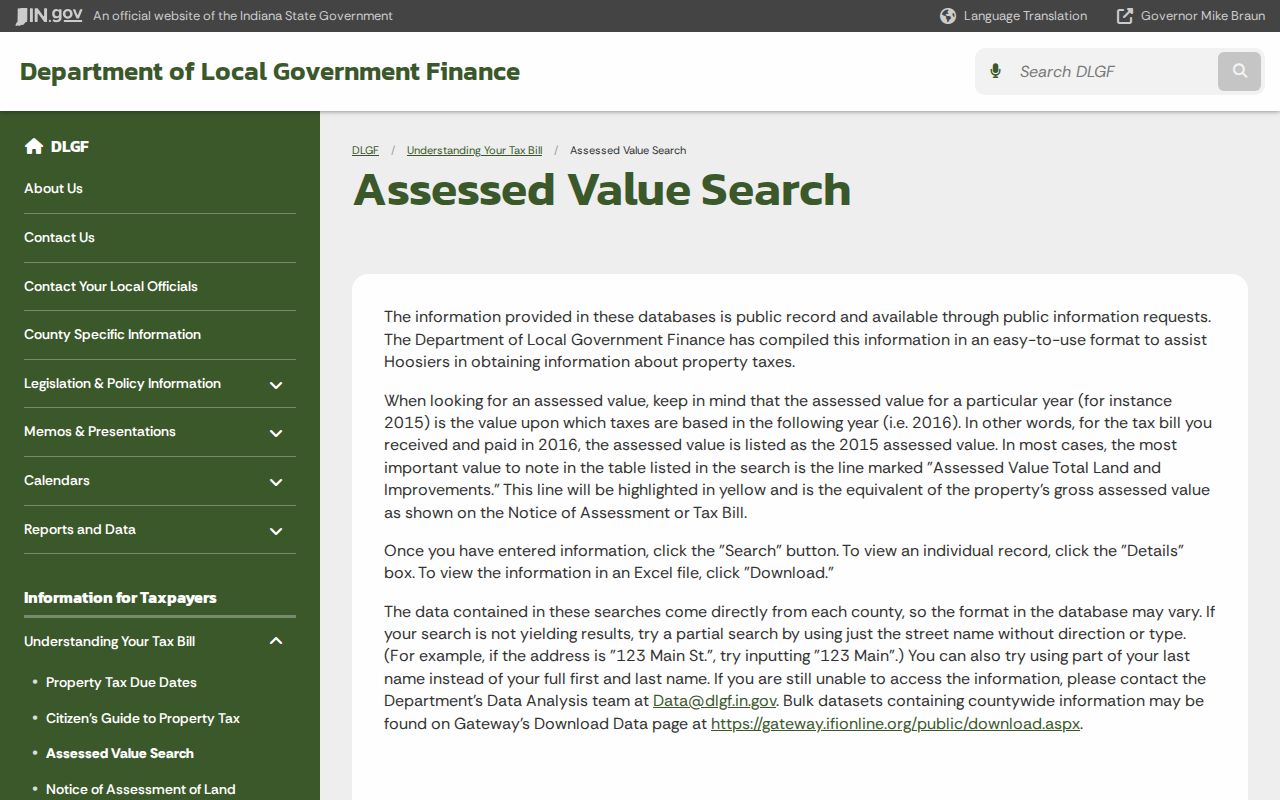
The DLGF Assessed Value Search supports county selection, partial street text, partial surname, detail views, and downloads. Search broadly at first. The Clay Tax List also offers Name, Address, and Property ID routes across its 26,075 records, while abbreviations can hide overly narrow street queries. Widen the text, then narrow by parcel and situs.
Confirm unclear results with the office when a split, recent improvement, or update date clouds the picture.
Understand Clay County's 100 Percent Ratio
Indiana assesses property at a 100 percent ratio to market value-in-use. That policy has limits. An assessment is not an appraisal. Ratio studies evaluate broad performance against qualified sales. DLGF approved Clay County's 2025 ratio study on April 2, 2025. The letter discusses statistical review, sales chasing, vertical equity, and compliant sales-disclosure files for the 2026 study. It describes a system review rather than a certificate for one home.
Compare Clay County Sale Price Carefully
Indiana's public Sales Disclosure search covers transfers after July 1, 2008. Treat any price there as dated evidence. It may concern a partial interest or a family transfer. The record may also involve several parcels, leased-land building, or a mineral interest. Each case weakens a direct comparison. So read the deed and disclosure before naming a market value. A later non-sale transfer can change ownership without a normal purchase price.
Track Clay County Trending and Reassessment
Statewide cyclical reassessment began July 1, 2026, with about 25 percent of parcels reviewed each year over four years. Clay County also posted a 2026–2030 procurement request. It covers several property classes, new construction, annual adjustment, and appeal representation. Verify the outcome with the Assessor.
Trending responds to market evidence. Cyclical reassessment reviews parcel data on a schedule. Save the year attached to each figure so later values aren't mistaken for numbers that existed on the same date.
Note: A changed value can stem from trending, corrected data, or a property change, so compare record details before naming one cause.
Keep Clay County Deductions Apart From Value
Deductions affect taxable results, not necessarily gross assessed value. The Auditor announced expanded over-65 and disability deduction qualifications in July 2025. Eligibility still belongs to the tax-record workflow. Report gross land and improvement figures first, label deductions separately, and use the Clay County property tax records guide for bills, deductions, and appeals.
Know What Clay County Property Value Cannot Prove
An assessment cannot promise a selling price. Nor can it fix a surveyed boundary or establish title. A recorded sale stays historical, while a private appraisal is a dated opinion written for its stated purpose.
Value is not price. Clay County assessed value serves tax administration. It is not a guaranteed sale price and is not a private appraisal.
Write down the exact number, its date, and its source. This simple habit kills a common myth. Many people assume a 100 percent assessment ratio means every value concept is the same. It is not. A strong worksheet lists gross land, gross improvements, total gross assessment, and each deduction on separate lines. The net taxable amount gets its own line too. Add the assessment year and the source update date too. Then note the transfer date, the disclosed sale amount, and the deed reference. Note anything that makes the sale a poor comparison. Never subtract deductions from the gross figure and call the result market value. Deductions shape tax treatment. They say nothing about what the property would sell for.
Characteristics need dates as well. New construction, demolition, a corrected square footage, a shift to agricultural use, or commercial income evidence can change the whole basis of comparison. A parcel split can too. When this year's record differs from last year's, compare the fields one by one. Ask the Assessor which documented change or trending evidence explains the difference. The public record often shows only the result. The judgments behind a mass appraisal stay out of view.
For neighborhood context, match use, location, size, and assessment year. Do not just grab the nearest high or low number. WTH GIS can help you spot nearby parcels. Its lines and labels are not valuation conclusions. A defensible Clay County property value explanation names the official number and its age. It also names the record that carries it. It also explains why a sale price or a private appraisal may reasonably differ.